Advantages of stainless steel buffer tanks
The role of a buffer tank in modern heating systems
A buffer tank plays an important role in modern heating systems. Especially in installations using heat pumps, a buffer tank helps stabilize the heating system and improve overall efficiency.
The tank acts as a thermal storage unit. Heat energy that is not immediately required can be stored inside the tank and used later when needed.
This helps prevent frequent start and stop cycles of the heating system. As a result, the system operates more efficiently and the lifespan of the heating components increases.
Why stainless steel buffer tanks provide long-term durability
Traditional buffer tanks are often made from coated steel. While these systems have been used for many years, the protective coating may deteriorate over time.
Stainless steel offers a far more durable alternative. The chromium content within stainless steel forms a natural protective layer that prevents corrosion.
This makes stainless steel buffer tanks highly durable while maintaining stable water quality within the heating system.
The evolution of stainless steel materials in heating systems
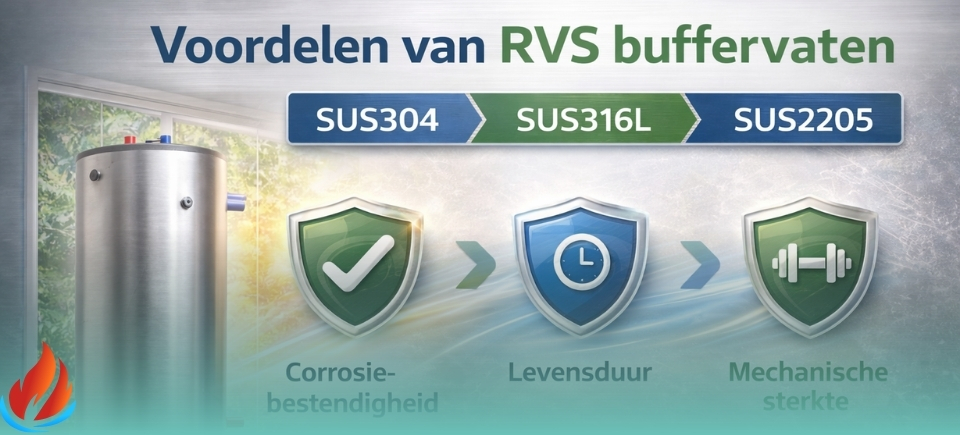
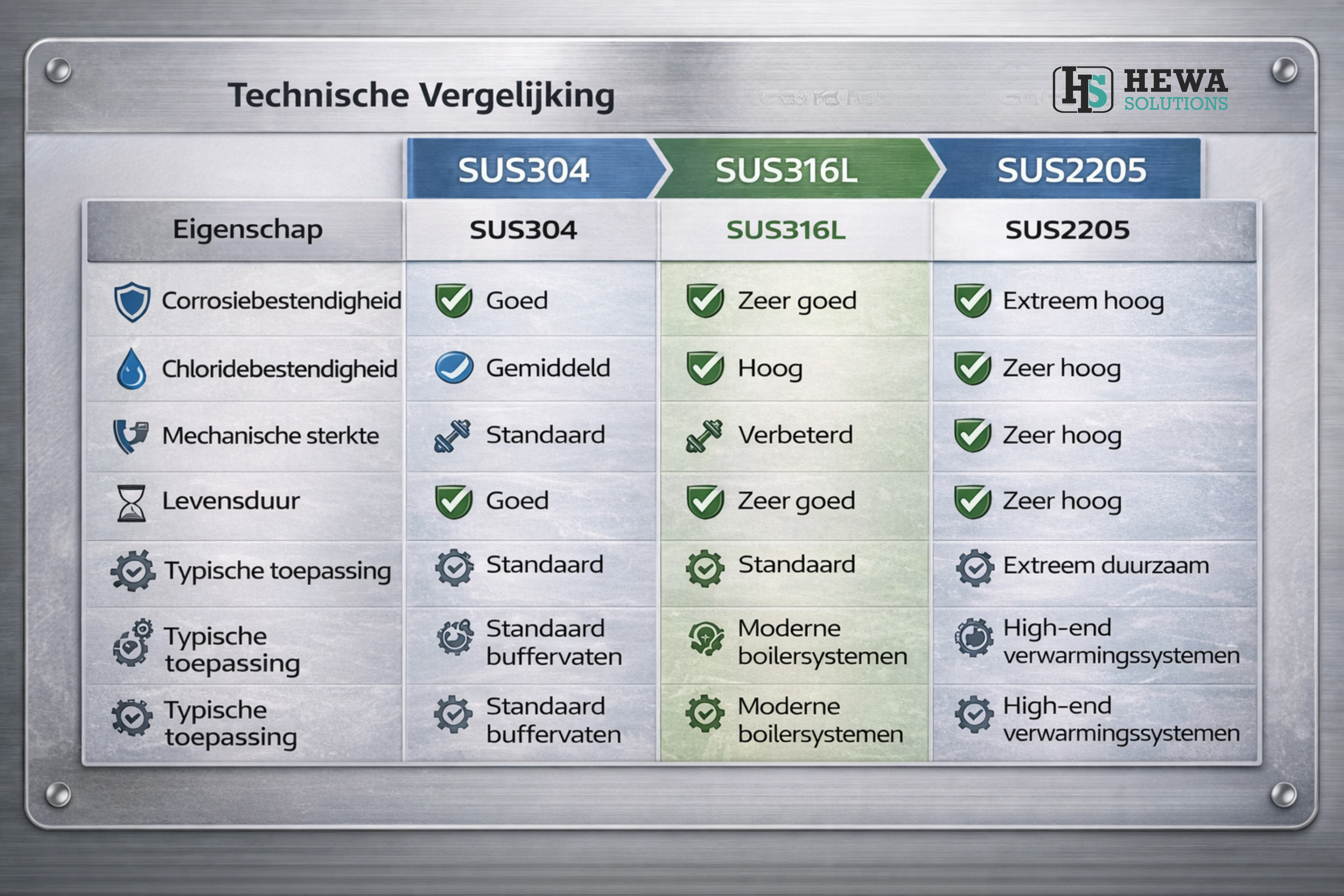
Material development in heating systems has progressed significantly in recent years. Earlier generations of buffer tanks often used SUS304 stainless steel.
SUS304 already provides good corrosion resistance and is widely used across many industrial applications.
Modern heating systems increasingly use SUS316L stainless steel. This alloy contains molybdenum, which significantly improves resistance to corrosion and chemical exposure.
The next step in this development is SUS2205 duplex stainless steel. This advanced material combines extremely high mechanical strength with excellent corrosion resistance.
Advantages of stainless steel buffer tanks
- Excellent corrosion resistance
- Long service life
- Low maintenance requirements
- Ideal for heat pump systems
- Stable water quality within the heating system
Applications in buffer tanks, hot water tanks and combination boilers
Stainless steel is not only used for buffer tanks. Domestic hot water tanks and combination boilers are also increasingly produced using high-quality stainless steel.
For domestic hot water systems corrosion resistance is particularly important because the tank continuously interacts with fresh water.
More information can be found on our page about buffer tanks.
Curious about the possibilities?
The transition from SUS304 to SUS316L and eventually to SUS2205 demonstrates how material innovation improves the reliability of heating systems.