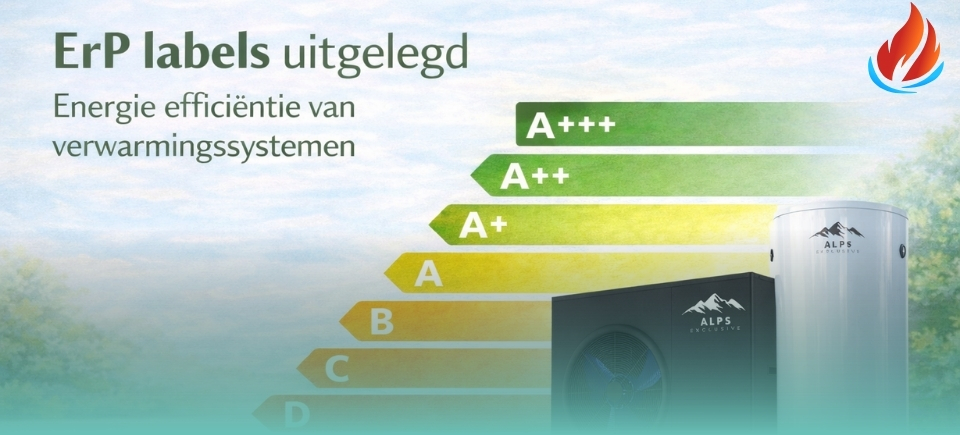
What are ErP labels and why are they important?
What are ErP labels?
When purchasing a heating system, heat pump, boiler or other energy-related product, you will often encounter an ErP label. These labels are similar to the well-known energy labels used for household appliances and provide insight into the energy performance of a product.
ErP stands for Energy-related Products. The label is part of European legislation designed to improve the energy efficiency of products and to help consumers compare systems more easily.
The goal of this regulation is to reduce energy consumption, encourage more efficient technologies and provide transparency in the market.
Why do ErP labels exist?
The European Union introduced the ErP directive to improve the energy efficiency of products placed on the European market. By defining minimum efficiency requirements and introducing clear energy labels, manufacturers are encouraged to design increasingly efficient technologies.
For consumers and installers, these labels make it easier to compare different systems and understand their expected energy performance.
Products with higher efficiency ratings typically consume less energy and can reduce long-term operating costs.
What information does an ErP label show?
An ErP label contains several types of information about the performance of a product. Depending on the product category, the label may include:
- Energy efficiency class (for example A+++ to D)
- Estimated annual energy consumption
- Noise level of the system
- Heating capacity
- Seasonal energy efficiency
This information allows consumers to compare products objectively before making a purchasing decision.
The European ErP directive
ErP labels are part of European regulations for energy-related products. For heating systems, EU Regulation 813/2013 plays an important role.
This regulation defines requirements for:
- minimum energy efficiency
- seasonal efficiency performance
- noise emissions
- technical documentation and product information
Products that do not meet these requirements are often no longer allowed to be sold within the European market.
ErP labels for heating systems
ErP labels are used for many types of heating technologies, including:
- heat pumps
- gas and oil boilers
- hybrid heating systems
- domestic hot water systems
- ventilation systems with heat recovery
For modern technologies such as heat pumps, these labels are particularly important because efficiency strongly influences the overall energy consumption of a building.
Why real performance may differ from the label
Although ErP labels are based on standardized laboratory testing conditions, real-world performance may differ.
This is because the actual efficiency of a heating system depends on several factors, including:
- building insulation
- local climate conditions
- installation quality
- user behavior
- system sizing
A properly designed and installed system can significantly influence the real energy performance.
The relationship between ErP labels and subsidies
The energy efficiency of a system may also influence government subsidies and incentive programs. Many sustainability schemes focus on technologies that deliver higher energy savings.
Systems with higher efficiency ratings often contribute more to energy reduction targets and may therefore qualify more easily for financial support.
You can read more about this in our article about sustainability subsidies and government programs.
Why energy efficiency is becoming increasingly important
Rising energy prices and stricter climate policies are making energy efficiency more important than ever. European regulations such as the ErP directive help accelerate the transition to more efficient heating technologies.
As a result, older inefficient technologies are gradually being replaced by modern energy-efficient systems.