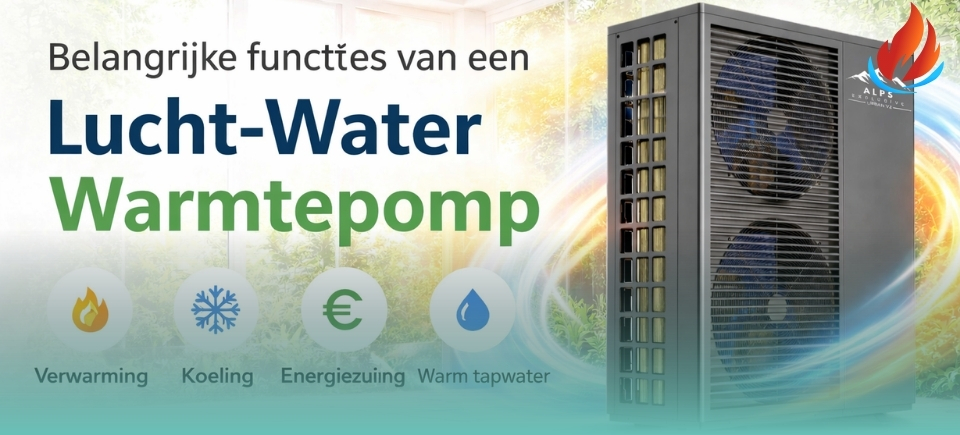
Key functions of an air-to-water heat pump
What is an air-to-water heat pump?
An air-to-water heat pump is a heating system that extracts heat energy from the outdoor air and uses this energy to heat water for space heating or domestic hot water.
This type of heat pump is one of the most commonly used solutions for residential heating systems. It operates using a thermodynamic cycle in which a refrigerant absorbs heat from the surrounding air.
The refrigerant is compressed to increase its temperature and the resulting heat is transferred to a water circuit. This heated water can then be used for heating systems such as underfloor heating or low-temperature radiators.
More information about these systems can be found on our page about heat pumps.
Heating and cooling with one system
One of the most important advantages of an air-to-water heat pump is its versatility. The system can provide both heating and cooling depending on the operating mode.
During winter operation the heat pump extracts thermal energy from outdoor air and transfers it to the heating system of the building. Even at relatively low outdoor temperatures the system can still capture useful heat.
During summer operation the process can be reversed. Heat is removed from the building and released into the outdoor air, helping to reduce indoor temperatures.
Energy efficiency and performance
Air-to-water heat pumps are known for their high energy efficiency. Instead of generating heat through combustion, they transfer heat that already exists in the environment.
The efficiency of a heat pump is typically expressed using the COP value (Coefficient of Performance). This value indicates how much heat energy is produced per unit of electricity consumed.
In many situations a heat pump can deliver three to five units of heat for every unit of electricity used. This makes the system significantly more efficient than conventional heating systems.
Lower operating costs in the long term
Thanks to their high efficiency, air-to-water heat pumps can reduce heating costs over time. Although the initial investment is often higher than traditional heating systems, the reduced energy consumption can offset these costs over the lifespan of the system.
In addition, many countries offer financial incentives for sustainable heating technologies. In the Netherlands, homeowners can benefit from the ISDE subsidy for heat pumps.
Flexible integration with heating systems
An air-to-water heat pump can be integrated with various heating systems. It works particularly well with low-temperature heating solutions such as underfloor heating.
Because these systems operate with lower water temperatures, the heat pump can run more efficiently. Low-temperature radiators and fan coil units can also be used in certain applications.
Sustainable and environmentally friendly heating
Heat pumps are considered a sustainable heating solution because they use renewable energy from the surrounding environment. A large portion of the energy used by the system comes directly from the air.
This significantly reduces the need for fossil fuels and lowers CO? emissions. When combined with solar panels, a heat pump can operate largely on self-generated electricity.
Domestic hot water production
Many air-to-water heat pumps are capable of producing domestic hot water in addition to providing space heating.
The heated water is typically stored in a hot water tank or buffer tank. This storage allows the system to supply hot water for showers, kitchens and bathrooms whenever needed.
By combining heating and hot water production in one system, the overall efficiency of the installation can be improved.
Curious about the possibilities?
An air-to-water heat pump offers an efficient and sustainable solution for modern heating systems. By combining heating, cooling and domestic hot water production, the system can serve multiple functions within a home.